Revolutionary Pumping Technology Advances for Mining Water Management
Published by Water Network Research, Official research team of The Water Network in Case Studies
Revolutionary Pumping Technology Advances for Mining Water Management
ByMuflih Hidayaton December 16, 2025

Modern mining operations face unprecedented water management challenges that require sophisticated technological solutions beyond traditional dewatering methods. The implementation of advances in pumping technology for modern mining water management has become essential for maintaining operational efficiency while meeting stringent environmental compliance standards. Furthermore, the integration of smart automation systems enables mining companies to optimise resource utilisation and reduce operational costs significantly.
The transformation from reactive water management to predictive resource optimisation represents more than technological advancement – it signals a paradigmatic shift in how extractive industries conceptualise water as both an operational necessity and strategic asset. Modern mining enterprises increasingly recognise that water management capabilities directly influence operational continuity, regulatory compliance, and long-term sustainability metrics.
The Technical Evolution from Basic Dewatering to Integrated Water Systems
Traditional mining water management relied heavily on single-purpose pumping installations designed for specific dewatering functions. These systems operated independently, with minimal integration between different water treatment stages and limited real-time operational feedback. Manual control mechanisms, including basic float switches and timer-based activation systems, provided rudimentary automation but lacked sophisticated response capabilities to changing operational conditions.
Contemporary data-driven mining operations have fundamentally restructured this approach through multi-stage treatment networks that integrate process water recovery with environmental compliance monitoring. This evolution represents a shift from reactive maintenance protocols to predictive system optimisation, where machine learning algorithms analyse historical performance data to anticipate equipment maintenance requirements and optimise operational parameters.
The integration of Supervisory Control and Data Acquisition (SCADA) systems has centralised monitoring capabilities, enabling operators to track critical parameters including:
• Flow rate variations across multiple treatment stages
• Pressure differentials throughout the pumping network
• Real-time power consumption analytics
• Motor temperature monitoring for thermal management
• Vibration analysis for predictive maintenance planning
Variable Frequency Drive (VFD) integration has eliminated inefficient throttling mechanisms by enabling precise motor speed control. This technological advancement allows operators to modulate pump output to match instantaneous demand, resulting in energy consumption reductions of 20-50% depending on system configuration and operational parameters.
Water recovery performance metrics demonstrate the substantial improvement over historical baselines. However, modern mining industry innovation trends consistently achieve higher recovery rates through multi-barrier treatment approaches compared to traditional single-stage dewatering methods.
Leading-Edge Pumping Technologies Transforming Water Management Operations
High-pressure filtration systems represent the technological frontier for tailings management in modern mining operations. Filter press integration enables significant moisture content reduction in tailings materials, with advanced configurations achieving 10-15% moisture content through polymer additive enhancement and optimised pressing cycles.
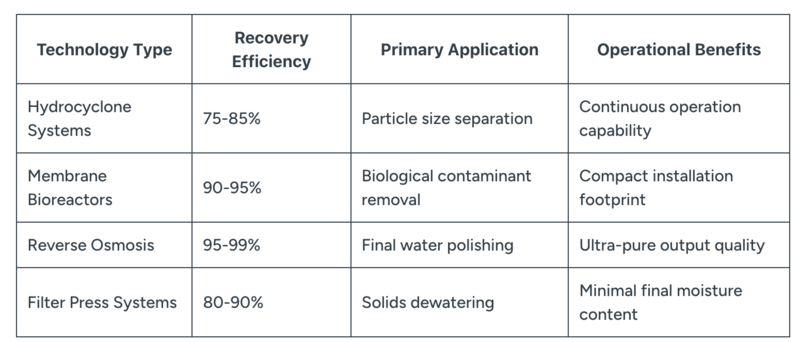
Membrane filtration technologies achieve 99%+ contaminant removal rates for particles exceeding 0.1 micrometers, according to standards published by the American Water Works Association. These systems enable mining operations to meet stringent discharge regulations whilst simultaneously recovering high-quality process water for operational reuse.
Vacuum-assisted dewatering systems provide 60-80% water content reduction through atmospheric pressure differential application. This technology proves particularly effective for fine particle suspension treatment where conventional filtration methods encounter operational limitations. For instance, advanced dewatering techniques have become essential for maintaining operational efficiency in challenging conditions.
Tags
Category: Case Studies
- Technology
- Mine Water Management
- Operations
- Water Management
- Water Treatment Systems
- water treatment operator