America’s biggest oil field is turning into a pressure cooker
Published by Water Network Research, Official research team of The Water Network in Business
Story by Benoît Morenne, Andrew Mollica MSN
Shale drillers have turned the biggest oil field in the U.S. into a pressure cooker that is literally bursting at the seams.
Producers in the Permian Basin of West Texas and New Mexico extract roughly half of the U.S.’s crude. They also produce copious amounts of toxic, salty water, which they pump back into the ground. Now, some of the reservoirs that collect the fluids are overflowing—and the producers keep injecting more.
It is creating a huge mess.
A buildup in pressure across the region is propelling wastewater up ancient wellbores, birthing geysers that can cost millions of dollars to clean up. Companies are wrestling with drilling hazards that make it more costly to operate and complaining that the marinade is creeping into their oil-and-gas reservoirs. Communities friendly to oil and gas are growing worried about injection.
“It’s one of the many things that keep me up at night,” said Greg Perrin, general manager of the groundwater-conservation district in Reeves County, Texas, where companies are injecting some of the largest volumes of wastewater.
Swaths of the Permian appear to be on the verge of geological malfunction. Pressure in the injection reservoirs in a prime portion of the basin runs as high as 0.7 pound per square inch per foot, according to a Wall Street Journal analysis of data from researchers at the University of Texas at Austin’s Bureau of Economic Geology.
When pressure exceeds 0.5 pound per square inch per foot, the liquid—if it finds a pathway—can flow to the surface and pose a risk to underground sources of drinking water, Texas regulators have said in industry presentations.
The fracas above ground is raising questions about how the Permian can sustain red-hot production without causing widespread environmental damage that could leave taxpayers on the hook—and complicate the region’s economic plans. The basin is trying to lure data centers with cheap land and energy and has plans to become a hub for burying carbon dioxide captured at industrial plants and sucked out of the air.
“You need to have a stable, locked-down geology that’s going to behave as it’s supposed to,” said Adam Peltz, a director at the Environmental Defense Fund, a nonprofit advocacy group. “Otherwise, you’re going to cause a huge, expensive mess that Texans will pay for for generations.”The industry is working to clean up its act, but solutions to treat and ditch meaningful volumes of water far from the oil fields remain years away.
Oil-and-gas executives said solving the wastewater issue is an industry priority.
“The size of the Permian is such that this can’t be a limiting factor for the success of the whole basin,” said Scott Neal, director of growth and portfolio for Chevron’s shale and tight business.
Unintended consequences
In the Delaware portion of the Permian, its most prolific region, drillers crank out between 5 and 6 barrels of water, on average, for every barrel of oil.
For years, they pumped the putrid fluids deep into the ground—and triggered hundreds of earthquakes, some with a magnitude of over 5. They caused little damage in the sparsely populated Permian, but they were felt as far as Dallas, El Paso and San Antonio, where a historic building was damaged.
In 2021, the Railroad Commission of Texas, the agency that oversees the oil-and-gas industry in the state, began cracking down on deep disposal. Companies pivoted to shallow reservoirs, which now absorb roughly three-quarters of the billions of barrels of water that they inject in the Permian every year. The shift largely cured the tremors but has created unintended consequences.
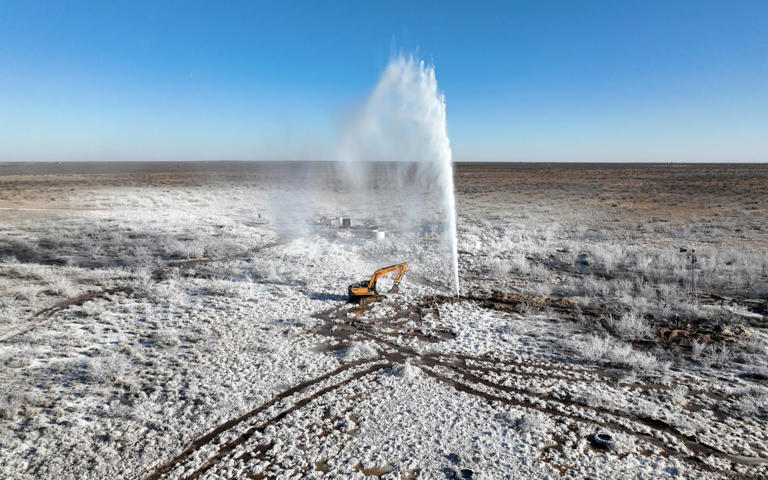
Saltwater erupted in 2022 from an abandoned well near the unincorporated community of Tubbs Corner, Texas.© Sarah Stogner
Pressure is mounting, and saltwater is being kicked out over vast distances. It is migrating up some of the decaying wells that litter the Permian, forcing companies and regulators to play a protracted—and expensive—game of whack-a-mole.
In 2022, a 100-foot column of saltwater erupted from an abandoned well in Texas’ Crane County near the unincorporated community of Tubbs Corner. Chevron, which owned the well, plugged it. But nearly two years later, water started to ooze from a different well in the same area, a sign that bottling up the geyser likely repressurized the subsurface and triggered the new outburst, scientists said.
It took the Railroad Commission about 53 days and roughly $2.5 million to plug that leak. Eventually, the agency quietly shut in the injection wells that it said were likely causing the increase in pressure.
The ordeal might not be over. The ground in the area has seen a slight uplift in recent months, a sign that pressure is building up again, scientists said.
Tackling the crisis
Regulators in Texas face a tough balancing act. Oil-and-gas production contributes too much to the state’s economy to be curtailed, but letting the situation fester risks turning supportive communities against the industry. Their task is complicated because New Mexico restricts disposal, so most of the Permian’s wastewater is injected in Texas.
Researchers at the Bureau of Economic Geology painted a critical picture of the frenzied injection in a preliminary, informal project proposal shared with the Railroad Commission last year, an open-records request filed by The Wall Street Journal revealed. Operators were injecting wastewater with little concern over how it might travel underground or its impact on reservoir pressure, they said.
“This behavior inexorably causes waste, regulatory action that impairs operation and investment, and reduction of the intrinsic value” of the injection resource, they said.
The commission has adopted a more-proactive approach to tackle the issue, industry experts said. Staffers routinely rely on satellite data to track down pressure buildups. Earlier this year, it said it would impose limits on injected volumes.
The Railroad Commission at times has appeared concerned about how the mounting crisis might reflect on it and the industry it regulates. It told the Texas Legislature last year that assembling a team to investigate the issue would help increase public confidence, the Journal’s open-records requests revealed. It received $1.3 million to hire the team. It also obtained an additional $100 million to plug leaky oil-and-gas wells.
Increasingly, Permian landowners find themselves dealing with abandoned well bores that come back to life. In May, a well on the Pecos County property of Laura Briggs started spraying saltwater like a fire hydrant. She said it took the Railroad Commission about four months to get it plugged at a cost of about $350,000.
“You’re working with broken, rotten pieces of stuff,” she said.
Some ranchers worry that wastewater might contaminate sources of groundwater and imperil their operations.
Tags
Category: Business
- Technology
- GIS & Remote Sensing Technology
- Geology
- IT
- Information Services
- Produced Water From Oil & Gas Industry
- Texas, United States